We recommend starting every project with a quote. This way, you can set clear expectations for the internal team and agree on its scope and price with the customer. The quote data automatically feeds into project reports, enabling you to compare the price proposal estimates with the actual results in real-time.
Watch the video to learn how to build a quote and estimate project delivery costs in Scoro. Use the GIF guide below to explore the flow at your own pace.
Jump to...
Create a new quote from any view
You can create a new quote from any view in Scoro using the quick actions menu. You'll find it at the top right corner wherever you are on the site.
Link the quote to a client
Before you start scoping the quote, link it to a customer. If you've previously added or imported contacts to Scoro, you can select the customer from the list.
Alternatively, enter the business name and click the [+] icon to fill in additional detail without leaving the view.
Scoro supports multi-currency planning and transactions. The preferred currency will appear automatically based on your site setup, but you can update it to match customer expectations.
Add deliverables, prices, and estimate costs
As you scroll down, the screen is divided into two sides: price proposal and internal cost estimate.
You can add deliverables on the left. Scoro’s flexible quoting capabilities let you structure and present your price proposals in a way that best suits your service offerings and internal workflows:
-
For deliverables where one person will be in charge of delivering the service, you can add the quote line items and simply select the necessary in-house role or user, or an outsourced supplier as the provider.
-
For deliverables where multiple roles or doers will deliver the work, start by adding the deliverables as quote line items. Next, open the estimation matrix view to add necessary roles and users, and plan how the workload and hours will be split among them. With this approach, you can present high-level deliverables to the client to keep the quote compact, while breaking them down internally by doers, effort, and cost to mirror your project plan.
Think of your quote lines as the high-level deliverables. When planning out the work later, they will become parent tasks, and you'll be able to break down the required work further with subtasks.
If you have entered the services into the product database, the prices and units are pulled automatically. You can update these details to reflect the needs of each new quote. If you're adding new services as you compile the quote, you can add units, quantity, and price from scratch.
The cost estimation on the right-hand side is where you can see and predict your internal costs and margin.
You can include either in-house or outsourced costs. If you have previously set up both in-house and outsourced services and added the price and cost info, the estimate will be populated with the respective data automatically.
For quote line items with multiple doers, the quantity and costs can be managed from the estimation matrix. For such deliverables, only in-house team members can be assigned in the estimation matrix; if an outsourced provider will carry out some parts of the work, you need to add a separate quote line item for that part.
To automate the quote creation process, you can predefine products and services, along with their associated prices and costs. This way, you can select services needed for the price proposal, and the relevant information is automatically populated.
Even with predefined services, you can adjust each new quote as you go, and the margin will update automatically to reflect the changes in pricing.
Structure your quote
You can structure your quote into sections. For example, if your project has several phases, you can highlight what you offer in each of them with the help of subheadings.
Just click on the [+] icon on the left-hand side of a quote line to add a subheading above it.
If your quote contains detailed service information that is more relevant for internal rather than external use, you can use subheadings to hide the details and provide only a summarized view to your customer.
Share the quote for customer approval
Once you've finished scoping and estimation, save the quote. You'll then be able to open a PDF version of the quote and review it before sending it to the customer straight from Scoro via e-mail.
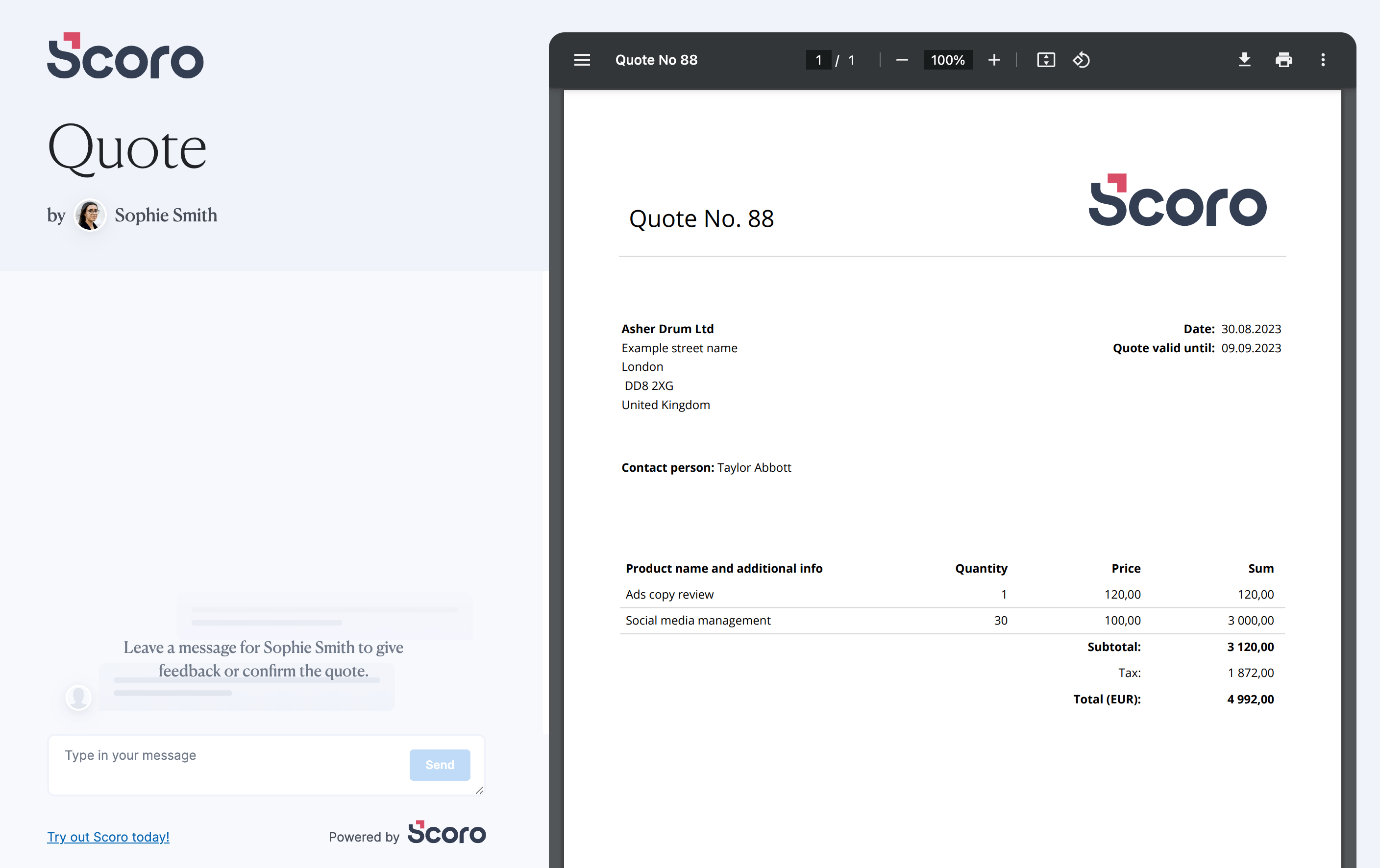
To reduce the number of back-and-forth emails and keep any discussions around the quote in a single compact view, we recommend sharing the quote via a unique link. This way, you can get customer feedback online and shorten the closing cycle.
Track quote progress in the Pipeline
You can keep track of all your active quotes in the Pipeline. Here, you can see the number of quotes you have issued and are actively working on, as well as how many deals are in each stage of the sales process.
Once a client agrees on the project price and scope, you can mark it confirmed and use its data to automate project planning. Follow the next step and learn how to convert your price proposal into a project plan.